Sunday, October 8, 2023

In a Nutshell

As some of you know, the Summers Saga being written is intended to go from the first U.S. Summers in my wife's line, Thomas Summers of Delaware, down to John William Summers and Verne Crabtree of Southeast Missouri, her grandparents, and their descendants. But sometimes diagrams are a little more explanatory than is prose. So here is the familial line that comprises the book's skeleton:

The Wittenberg Summers Line

Omitted from the chart are grandkids and great grandkids of John and Verne, many of whom will appear in the book. Also appearing will be the siblings, spouses, etc of all these people as well as some Duckworths, Dillards, Lambs, Crabtrees, Funkhausers, and other strays. You'll have to read the book to see how all these fit in.

Since the book ends with the descendants of John and Verne Crabtree Summers and because the last place John, Verne, and their five children lived as a unit for any significant time was Wittenberg, Missouri, I am going to call this the "Wittenberg Summers Line."

The chart above shows the book's familial journey. Here is the geographic journey:


Saturday, October 7, 2023

Quail Hunter

The Wittenberg map in our last blog contained the note “BRIDGE WHERE POSSE HID IN 1922 WHEN ‘QUAIL HUNTER’ KENNEDY WAS KILLED”. Here are the details.

John F. (“Jack”) Kennedy (yes, same name as the future president) was a notorious railroad bandit who was a suspect in a series of train robberies in the late 1890s. But despite bragging incessantly about his exploits, Jack proved almost impossible to lock up owing to well-planned alibis, lack of reliable witnesses, poor legal processing, etc. He received the nickname “Quail Hunter” after claiming to authorities that he was hunting quail when, following a fall from his horse, he was found with two Colt revolvers, a sawed-off shotgun, a mask and false whiskers and a lantern with a red cloth wrapped around it, something that could be used to signal and stop trains He was finally convicted in 1899 and served twelve years in the Missouri Pen before being paroled in 1912. Following his release, Jack claimed to have reformed. He went on tours, showing a film he made of him robbing a train and giving lectures (he called them “sermons”) about the importance of honesty. But Jack had not reformed and eventually went back to holding up trains, though this may have been as much for fame as fortune.

In the early morning of 3 Nov 1922 “Quail Hunter” held up a Frisco train, the "Memphis Flyer," near the little town of Seventy Six, Missouri. He and an accomplice uncoupled the passenger cars, and drove off with the locomotive and the mail and express cars. A few miles down the track, they stopped the train, robbed the mail clerks of several pouches, disconnected the locomotive, and drove south down the track past the Wittenberg station, where John William Summers was working. (Before his life of crime Kennedy had worked briefly as a locomotive engineer for the Southern Pacific.) "Quail Hunter" then stopped the locomotive near a bridge across the Brazeau River just south of the train station, where a getaway car was waiting. But there had been an informant and eleven armed lawmen (postal inspectors, RR detectives, sheriff's deputies) were also waiting.


Bridge where “Quail Hunter” met his end (photo 2011).

“Quail Hunter” Kennedy and his young accomplice were killed in the ensuing gun battle. The incident made papers around the country. John William Summers and his family likely saw the bodies. Hundreds of spectators filed past the bodies of the two slain bandits at the Wittenberg undertaker’s establishment.


Interested in more about the Quail Hunter? Archaeology scholar Cameron Lee is doing an outstanding job of researching him. See Hunting the Quail Hunter.


Tuesday, September 26, 2023

Wittenberg

John William Summers and his family spent a little over ten years in Wittenberg, Missouri, where John was a Frisco telegrapher and a station agent. When the family moved there around 1920, the town had a population of only 270 people. But despite its meagre size, Wittenberg boasted a brewery, a furniture factory, a flour mill, two grocery stores, two hotels, and John Summer’s Frisco railroad station, the latter giving the village a reason for being.

Old Wittenberg (Warren Schmidt, Perry County Lutheran Historical Society).

A map of Wittenberg Mo in the 1920s has been handed down through the Summers family. It is likely that the map was drawn by one of John William’s children. Note the comment in the lower right "BRIDGE WHERE POSSE HID IN 1922 ..." This is the site where John F. "Quail Hunter" Kennedy was killed following his Frisco train robbery, but more on that in a future blog.

A black circle has been added to mark the location of the Frisco Depot

Today Wittenberg has a population less than ten. Some say it is only three. Wittenberg’s death was caused by periodic flooding, which increased when levees along the Mississippi were raised.

Standard Atlas of Perry County, Missouri, 1915, p. 40. The RR depot is circled.


Thursday, September 21, 2023

A Frisco Career


John William Summers
Verne Cumi Crabtree
It is planned that the book A Summers Saga will conclude  with John William and Verne Cumi (Crabtree) Summers and their descendants. Of course this is still well off in the distance. Nevertheless, the draft has Thomas of Delaware as the port of departure and the John and Verne Summers family, the destination.

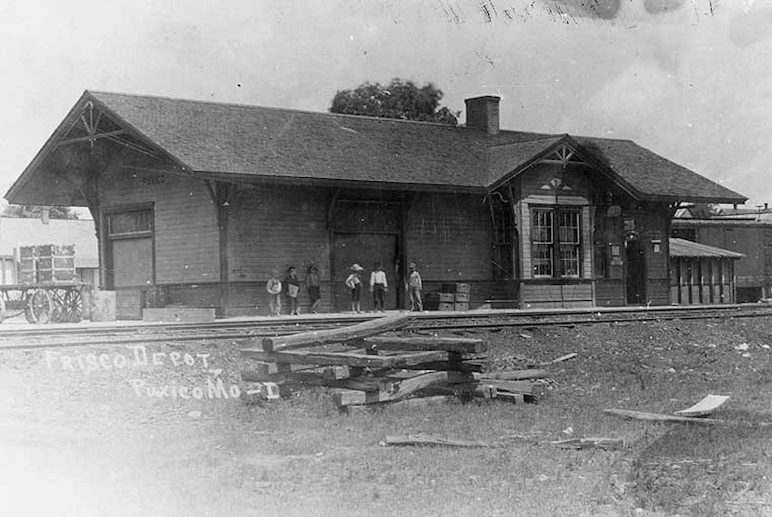
John William was employed by the Saint Louis and San Francisco Railroad, the “Frisco,” a line that never went near San Francisco. The “Frisco” operated primarily in Arkansas, Kansas, Missouri, and Oklahoma, although a portion of the 5000 miles of track also lay in Alabama, Florida, Tennessee, and Texas. Headquartered in Springfield Missouri, the “Frisco” was incorporated on 6 Sep 1876. With the “Frisco,” John worked his way up from laborer to telegrapher and station agent. Around 1910, while still single (though he would soon be married), John began his railroad career as a laborer in the Missouri town of Puxico.
Puico was the center of the timber industry, whose main clients were the railroads, which needed ties and bridge materials. Rails had first been laid through Puxico in 1883, by the Cape Girardeau Southwestern Railroad, and the town had been incorporated the following year. 
Puxico Frisco Station, c1903


Puxico Frisco Station, now a museum. 2007.

John then worked as a station agent in the now-defunct town of Boynton, Arkansas, the home of the newly wedded couple. Next he was a telegrapher in Delta, Missouri, while living in Ilmo. Then, a little before 1920, John became a telegrapher and station agent in the tiny Perry Co town of Wittenberg, Missouri, located on the Mississippi River, about one hundred miles south of St. Louis and 30 miles north of Cape Girardeau. In 1930 his family moved to Pocahontas, Arkansas, where his career and his life ended on 21 Dec 1932.

Now-abandoned Pocahontas Station, John’s last workplace, 2007.


John was only 43 years old when he died of influenza followed by pneumonia. On Wed 21 Dec 1932, his son Dale was on way home to Pocahontas from college by train for Christmas and had fallen asleep. A conductor came by and woke him up, saying “are you John Summers boy.” When Dale said “Yes,” the conductor responded, “Your Dad is dead.”


Sunday, September 17, 2023

A Summers Saga

Well, I’m finally actually writing the Summers book, working title: A Summers Saga, The Wittenberg Summers. I must admit, however, that the subtitle might be misleading. Wittenberg is Wittenberg, Missouri, not Wittenberg, Germany. The former is where John William Summers, telegrapher and station master for the Frisco Railroad, and his family lived before the family relocated following John's early death.

This book arises from a rash promise I made to my life’s companion and BFF, Mary Frances—a  promise that I would document the origins of her parents, Dale and Eloi
se (Wehner) Summers. With the completion of a volume (tome?) about Eloise’s origins (Bier und Brot), it’s Dale’s turn, starting with his 4th great grandfather, Thomas Summers of Delaware.

The present book follows a single line (more or less) descending from Thomas. Were all Thomas's lines covered, the book would require decades to complete and a warehouse to shelve. I have available neither the decades nor a warehouse.

The book’s line starts with Thomas and ends with the family and descendants of John William and Verne Cumi (Crabtree) Summers (Dale’s parents). Covered is the journey of John’s antecedents from Delaware to North Carolina to Tennessee to Southern Illinois and, finally to Southeast Missouri. The proposed cover shows Tower Rock, emerging from the Mississippi near the town of Wittenberg, Missouri, the last place John, Verne, and their five children lived as a unit for any significant time. For convenience I call this family line, the "Wittenberg Summers Line." To avoid a bulky name, I am leaving out "Missouri," even though there is a danger of confusion with Wittenberg, Germany.


Friday, May 20, 2022

John Alexander Summers

Source, Coty Herring.
 Back in 1933 Sara John English, an avid Illinois historian with an affinity for military graves, wrote a newspaper article about Col. John Summers (middle name probably "Alexander" since he had a son John Alexander Summers Jr.). Though containing an error or two, the article, which included an interview with John Summers's son Thomas Jefferson Summers, provided quite a bit of reliable information. And it was at the same time a rather beautiful elegy for a soldier (with borrowings from the poet James Buckham). But the article was later transcribed by a Summers historian, now deceased, who made changes throughout in grammar, punctuation, word order, syntax and a large mistake in John's birth year. John's gravestone was reported by Sara to be marked "June 5, 1794," not "June 5, 1789." The poor transcription has been used over and over by Summers family historians and has spread throughout the internet. I ran across a photo of the original article and here is a word for word and, I believe, absolutely correct transcription. And why have I not included the newspaper and exact date? Because I have yet to find them. But I will.

DISCOVERS [GRAVE]
       OF COLONEL
             WHO SERVED IN 1812

 Jacksonville Woman Relates Trip to Scott County Finding Burial Place of Early American Patriot.

 BY SARA JOHN ENGLISH

The way of the research worker is over rough and rugged paths, past logs, over barbed wire fences, through swarms of grasshoppers, hornets, and bumblebees’ nests, and cockle-burr patches, and down into the holes of foxes, waist deep. But oh! the joy of finding the grave of a long lost patriot or pioneer erases all the memories.

In the most out of the way spots we find, “beneath the roots of tangled weeds, afar in country graveyards, lie the ones whose uncrowned deeds have stamped the nation's destiny, beneath the tottering slabs of stone whose tribute moss and mould efface, sleep the calm dust that made us great, the true substratum of our race.

Only recently in a weed patch in Philadelphia was found a stone bearing this inscription, “In memory of Capt. John Gwinn, U. S. Navy. Died in Palermo, Sicily, Sept. 4, 1849, while in command of the U.S. frigate Constitution. He served his country faithfully for forty years.” Near him, covered with weeds, was his wife who had died 35 years after her gallant husband. His body was recently buried in Arlington National cemetery with great honors; his wife will rest at his side.

This find seems to spur one on, wondering what brave and sturdy patriots rest in our weed covered graveyards. John W. Lazenby called me Saturday to tell me that a “colonel” was buried in a graveyard on the farm of Jeff Wilson about three miles south of Winchester, on the Glasgow Road. Claude Workman had recently lived on the farm, and had turned over the fallen grave stone and noticed that it was to a “colonel.”  

We visited farms, hailed men on the road but no one could solve the mystery. After we found the spot, the inscription read.. "Col. John Summers, born June 5, 1794—died Nov. 6, 1869," but no one seemed to know the colonel. We visited Scott county’s tablet to all the war dead and found his name was missing.

Curiosity spurred us on, until we found Homer B. Summers, who sent us into Winchester where we found a real son of 1812, Thomas Jefferson Summers, a son of the Colonel. He and his charming wife gave us the following authentic record of the colonel:

“Col John Summers was born in Tennessee, fought in the war of 1812 from LaGrange County, Tenn. For his gallantry in resisting British and Indian attacks, he was made colonel of a regiment when almost a youth. For his service in the war he was given 160 acres in Illinois and came to this state and settled, He reserved one acre of land for burial purposes, but now the gravestones are broken by cattle, for the plot is a pasture. Summers’s grave stone is broken in three pieces but retains the crossed staves of Britain and the U. S. to indicate the war of 1812.

“Col Summers was married three times, first to Sarah Jackson of Tennessee, second to Miss Todd, third to Louisa Lankford. By his last wife he had six daughters and four sons. He married his last wife in Scott County in 1843. He also served as a private in the Black Hawk War.”

Thomas Jefferson Summers married Miss Artilisa Dyer, a daughter of the pioneer, Dennis Gibson. They will have been married 69 years in December of this year. In their home old Col. Summers died of a fever in 1869 after a few days’ illness.

Real sons of 1812 are rare and we hold their links with the past as precious.


Tuesday, May 10, 2022

John William Summers "Obit"

I have never seen such a difficult family to trace - a widespread common name and few records. But what makes it particularly difficult is to determine what to accept and what to mistrust. Unsourced trees, conflicting data, impossible dates, and now questionable obits. The following obit has been posted on the internet, but is it reliable or was it just invented based on "accepted information"? No source (newspaper) is given, the obituary is written the way modern obits are written and seems far too detailed, particularly for the time.  Was it published in 1889 or was it created recently by a family historian. I vote for the latter, particularly since my request for its origin has gone unanswered. I have no complaints about an obituary being written well past the death of an individual, as long as it is presented as such.


OBITUARY - John William Summers

WINCHESTER - JOHN WILLIAM SUMMERS, 63 years 11 months 21 days, passed away on July 26, 1889 at his home from complications of a stroke suffered two years earlier. He was born August 5, 1825 in Logan County Kentucky to William and Jane Ross Summers. He was brother to Joseph, Elvira, Polly and Jane. On September 21, 1848, he was united in marriage with Miss Sarah Ann Peek his loving wife of 41 years. She survives. He was preceded in death by his parents and sons Joseph L and Samuel P. He is survived by ten children. They are, Jane Lawson, Flora Ellen Howard, Charles H (Elizabeth), Thomas (Laura), George L (Ida), William (Lillie), Alice Headrick, Lottie Todd , Frank (Nicholina) and Ludella Seymour.

Mr. Summers was a member of Pioneer Lodge, No. 70, Independent Order of Odd Fellows, and abided always in the principles of friendship, love and truth. He was a consistent member of the Methodist Episcopal Church and was honest, correct and fair in his dealings with his fellow man. He taught two terms of school at Harts (Sandy precinct). During one of these terms the Mexican war broke out. He left his school and went forth at his country's call, a volunteer, and served faithfully through the struggle. He received an honorable discharge (which is still preserved as a memento by the family) came back and finished teaching his term of school. In 1875 Mr. Summers was elected a member of the board of county commissioners. He served two terms. Mr. Summers was considered one of the best financiers ever in charge of the county's affairs. He also served as magistrate at Winchester for twelve years. Mr. Summers was a business man and farmer in and around the Winchester area.

John will be missed by all who knew and loved him. He was a devoted and loving husband, father and grandfather.

Services were held at the Methodist Episcopal Church with burial in the family plot at the Winchester cemetery


And now I have finally stumbled across the truth. An internet copy of this has been found ending with the statement "This is a composite obituary created from several different documents located in the Scott County Illinois archives." In other words, it has all the reliability of a researcher's tree. None. I would like to thank the author for revealing the source, yet people continue to cite this "Obituary" as if it were contemporary to the time. It is not. In the absence of verbatim copies of all the documents used in its composition, it cannot be trusted. But who is listening?