Mary Frances and I recently returned from a 4000-mile (or so) trip to investigate Summers and Tapscotts. The excuse was to attend the Tapscott Family Reunion in Fauquier County, Virginia, but family research was also a motive. We spent loads of time in/at museums, historical societies, archives, and cemeteries researching Tapscotts (my family) and Summers (Mary Frances's family). And for the Summers, we started where our knowledge of the line (which I term the “Wittenberg Missouri Summers” line) begins, in Delaware, a state new to both Mary Frances and myself.
It all started with Thomas Summers, a well-to-do
early 18th-century planter, who owned several hundred acres of land in the
Mispillion Hundreds area of Kent County, Delaware. Oh, there are countless published trees
out there (well over three thousand on the internet at Ancestry.com alone) that
carry the line beyond Delaware, back to England, claiming that Thomas was born at
various dates in Newcastle on Tyne. But nearly all of those three thousand plus
trees give other trees as sources. A case of trees referencing trees. And those
very, very few that cite baptismal and/or birth records for a Thomas Summers
fail to prove that the Thomas Summers in the record is the same as the Delaware
Thomas Summers. There are, unfortunately, a huge number of Thomas Summers in
the world. Perhaps someday we will find some documents here in the U.S. that
will allow us to reliably trace Thomas’s ancestry back to the old world, but
that someday has yet to arrive.
 |
Mispillion Hundred in Kent,
one of
Delaware’s three counties. |
Thomas likely did have his roots in England, the home of
many Summers. He may have arrived in New York in 1720, since this is the only
known arrival of a Thomas Summers near the time our Thomas first appears in
this country. Note, however, that another Thomas Summers arrived in Maryland in
1678, and Maryland is quite close to Delaware. Nevertheless, the earliest
concrete thing that we know of our Thomas Summers is that on 12 May 1741 he
obtained a warrant for 200 acres of land in Mispillion Hundred in Kent County,
Delaware.
 |
Mispillion Hundred area of Colonial Delaware.
|
And what is Mispillion Hundred? A “hundred” was a term used
in Old England for a piece of land that could supply one hundred men at arms or that
could support one hundred families, take your choice, for the origin of the
term is obscure. In the new world hundreds were simply portions of land, with varying areas, within a
county, essentially townships. Delaware still uses the term “hundred” as a land
unit.
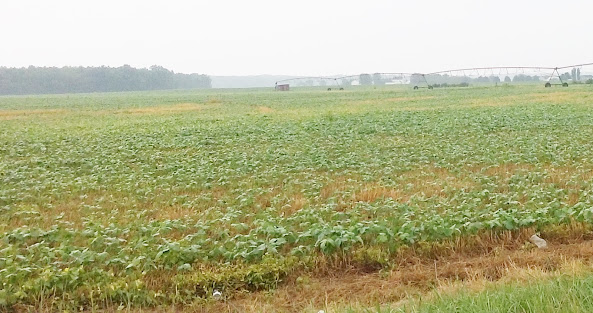 |
A few woods remain, but most Mispillion forest
has been
replaced with farmland (2019).
|
The designation “Mispillion” came from the name of the creek
flowing through this hundred, but the origin of the name of the creek is
uncertain. A 1664 map shows the name Mispening Creek. Mispillion is the largest
Hundred in Kent County though it is smaller than it was in colonial times, when
it occupied all the land south of Murderkill Creek and north of Mispillion
Creek from the Delaware Bay to the Maryland line. In early times, the area was
covered with forest (largely cleared today) and in deeds the term “forest of
Mispillion Hundred” was often used.


