Sunday, February 18, 2024

The Orphans

Despite having nine children from three marriages (see The Mysterious Tillman), James Jordan Summers, Lucinda Russel, Rosetta Cole, and Tillman Andrew were short-lived. Tillman lasted the longest, dying (by his own hand) around age 48. Lucinda passed around 45, James Jordan about 38, Rosetta under 25. By 1897, or so, all four parents were dead. And what happened to the orphans? Here are their stories, combined with charts in hopes of simplifying things.

In 1900 William and Mary were living with their Aunt and Uncle.

In 1900 James Jordan and Rosetta (Cole) Summers’s children, William and Mary Elizabeth had moved in with (or been "farmed out" to) their aunt and uncle Amanda and Squire (also, “Esquire”) Mooney in Lisman, Webster Co, Kentucky. Amanda was Rosetta Cole’s sister.

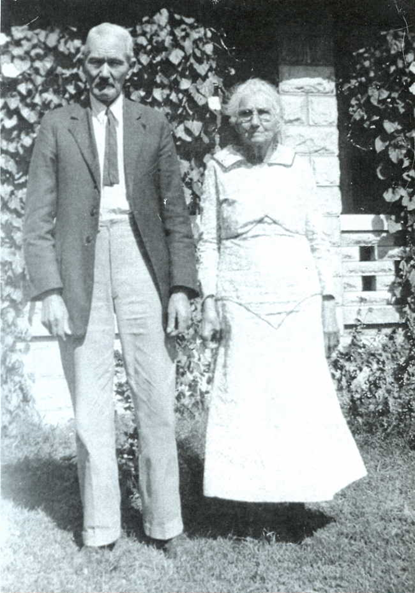
Albert and Mary Elizabeth Craig.
 (Katharyn Silva Belew, Ancestry.com.)
Born 23 Oct 1884, in McLeansboro, Hamilton Co, Illinois, Mary Elizabeth Summers lived only briefly with her aunt and uncle. On 16 Nov 1900 she married William David Keller in Henderson Co, Kentucky, a marriage that ended in divorce in 1910. Mary next married Joseph Eich in Knox Co, Indiana, 5 Nov 1917, and when Joseph died on 13 Jan 1944, she married Albert Granville Craig in 1948. Mary died 22 Dec 1965 in Vincennes, Indiana. Despite three marriages, Mary Elizabeth had but a single child, Carlus Clinton Keller, product of her first marriage.

We know a lot about Mary Elizabeth but almost nothing about her brother, William Summers, who is found in the 1900 census as a nephew living with Amanda and Squire Mooney and is never seen again. That census gives his date of birth as Oct 1881 with Kentucky as his unexpected birthplace.

By the time that Lucinda, the last living parent, died, some of the orphaned descendants were no longer children. Tillman and Lucinda’s three oldest were married, all three in Franklin Co, Illinois—William Andrews to Hester Hutchcraft on 5 Jun 1894, Lewis Robert Andrews to Nancy Ella Kerney on 11 Jul 1895, and Thomas B. Andrews to Marjorie M. Waller on 3 Dec 1896.

By the time their parents had died, the three oldest Andrews were married.


And by 1900, the unmarried Andrews, the three youngest—Lawrence, Nora, and Anna Mae—were living with their married brother Lewis Robert in Northern Twp. Franklin Co. Also living with Lewis Robert in 1900 was his half brother, ten-year-old John William Summers, the youngest of all the offspring. That John William was taken in by Lewis was probably the reason that John and his future wife, Verne, maintained contacts throughout their lives with Tillman’s children and grandchildren. And many of John and Verne's descendants did the same.

The subject of our next blog is where John William Summers and his Andrews half-siblings ended up.

Sunday, February 4, 2024

James and Rosetta

Marriage License Cover
The descendants of William K Summers have been extensively researched by Judith (“
Judy”) Somers, wife of Dale Somers, William K’s great grandson. (The spelling of the last name was changed.) Before Judy died in 1992, she corresponded with Verne (Crabtree) Summers, wife of James Jordan’s son from his third marriage, John William Summers (see The Mysterious Tillman Andrew), passing on abstracts of Illinois courthouse records. Among the abstracted records were those of James Jordan’s 1879 marriage to Rosetta “Caul” in Hamilton Co. There were two highly questionable things in the abstracts. First was the claim that the records showed this to be James’s second marriage. He had apparently been married once before, but to whom nobody knows. Second was Rosetta’s middle name, transcribed by Judy as “Filone,” and changed by some to “Trilone” or “Frilone.” And it would be interesting to see if Rosetta’s family name was really given as “Caul.” It seems like a good time to take a look at digital copies of the original records, rather than abstracts, and here they are, from the Hamilton Co courthouse.

Marriage License


Marriage Return
The handwriting on the Marriage Return is poor and there are some errors. James’s mother’s name was “Nichols,” not “Nickles.” Rosetta was probably born in Webster Co, Kentucky, not in nonexistent “West Vill Co Ky.” And her family name is given as “Coal,” not “Caul” as transcribed by Judy, nor “Cole,” as given on the Marriage License Cover, which it really was. Of course, that James and Rosetta were Illiterate (as shown in the 1880 Hamilton Co census) did not help.

The Marriage Return does indeed state that with this marriage James had been married “Twice.”  But the bride’s middle name is not “Filone” or “Frilone” or “Trilone.” It is obviously “Freelove.” Why are we so certain, given the overall poor handwriting? In the 1860 census, Rosetta’s parents, Robert and Lucy, were living in Webster Co, Kentucky, next door to another Cole family with a daughter named “Freelove Cole.” The families were almost certainly related, particularly since the 1850 census shows the same Cole family as well as Rosetta’s parents living in Allen Co, Kentucky, along with a large number of other Coles, sixty total. It appears that “Freelove” may have been a family name. The Allen Co Coles originated in Virginia. Various records show that state to be the birthplace of at least three different 18th- and 19th-century women bearing the name “Freelove Cole.” And the writing of the name is relatively clear in the Marriage Return.

Lucy Cole's Hamilton Co Marker (Find A Grave).
The digital images of the marriage records show three other things of interest. (1) Rosetta apparently gave her name as “Rosety,” though it does appear as “Rosetta” in the marriage license. (2) She was married in the house of her father Robert, known to live in Knights Prairie Twp, Hamilton Co. (3) The witness was Rubin Dial, the brother of Rosetta’s stepmother, Mary Dial. Prior to Rosetta's marriage, her biological mother, Lucy, had passed away, sometime around 1868, presumably in Hamilton Co, where she is buried.

If you would like free no-strings-attached copies of the marriage documents and my transcriptions, just click on the link below. You don’t need the Dropbox app. If, at this point, you get a “Log in or Sign Up message just ignore it. Press the download button at the top of the web page. You will then get (another) “Log in or Sign Up message. Just click Or continue with dropdown only at the bottom of that message. You need not log in or sign up. It is not necessary to be a Dropbox user. Leave a comment or send me an email if you have problems.

Thursday, January 25, 2024

The Mysterious Tillman

The Wittenberg, Missouri, Summers are descended from James Jordan and Lucinda (Russell) Summers. But Lucinda had been married once before. On 23 Jan 1870 in White Co, Illinois, Lucinda had married Tillman Andrew. And Tillman left sufficient mysteries to keep a dozen Sherlock Holmeses busy.

The first mystery is Tillman’s origins. According to Illinois census data he was born c1844 in Maryland. The Illinois Roll of Honor, a secondary database maintained by the State of Illinois showing residents who served in the military, claims that Tillman “Andrews” served in the Maryland infantry during the Civil War; however, no reliable military records are found showing such service. Although the database is maintained by the State of Illinois, it was given the State by Fred Delap of Kansas, Illinois. The Civil War entries are said to have come from the Report of the Adjutant General of the State of Illinois. The name Tillman Andrew or a variant thereof, however, does not appear in any of the eight volumes of the adjutant general’s report. The creator of the database is now deceased.

Los Angeles death certificate for a different Tillman Andrews

And Tillman’s parentage is unknown. He is sometimes said to be Tilman (also, “Tilghman,” a known variant of the name) D. Andrew, born in Maryland c1845 to Richard and Rebecca Andrew as seen in 1850 and 1860 census records; however, Tilman D. is known to have moved to California, where he married in 1872, lived, and died in 1911. The death certificate shows his parents to be Richard and Rebecca..

The Illinois Tillman, who appears with the surname “Andrew” in earlier documents but as “Andrews” in later (mostly secondary) records, and Lucinda had six known children, all named “Andrews.” Then, around the time the last child was born, 1886, Tillman walked out the door and vanished.

Lucinda waited a couple of years or so and then, assuming that Tillman had died, she married again, with James Jordan Summers, on 30 Jan 1889 in Macedonia, Illinois. James was widowed, his wife Rosetta (“Rosie”) had died, leaving him with two young children, William and Mary Elizabeth.

James died young, around age 38, on 14 May 1890 according to Betty Jenkins Summers, the wife of James Jordan’s grandson Michael, though how she (or Michael) would know is unknown, and both are now deceased. James and Lucindas brief marriage produced a single child, John William Summers Sr, born 4 Sep 1889 in Macedonia.  When James died, he left a house full of children for Lucinda, two from James’s previous marriage, six from Lucinda’s first marriage, and newly-born John William Summers, who would not have remembered his father.

And then the unthinkable happened. Tillman returned! In Nov 1892, he walked in the door unannounced, claiming that two detectives were after him. And then, after a few days, on 21 Nov 1892, he put a gun to his head and pulled the trigger. The incident made newspapers across the country. Many with headlines mentioning “Enoch Arden.” (I leave it to the reader to figure out why.) Tillman is said to be buried in Macedonia Cemetery, though no marker is found.

Pension Index Card showing the alias
Following the loss of two husbands, Lucinda married a third, John H. Cozart, on 8 Sep 1894 in Franklin Co, Illinois. Lucinda’s last marriage was short and childless. She died around 1897. But before that, in 1895, John Cozart applied for a Civil War pension based on Tillman Andrew’s service to help support the many minor children John inherited when he married Tillman’s and James Jordan's widow. And this brings us to a final Tillman mystery. The National Archives Pension Index Card for John Cozart’s application states that Tillman Andrews served with the 3rd Regiment, Massachusetts Cavalry, not the Maryland infantry, which is shown in the Illinois Role of Honor. And much more mysterious is that the card states that Tillman had an alias — William W. Downes! There was a William Downes, of Delaware, who served in the 3rd Regiment of the Massachusetts Cavalry. And William's approximate year of birth, based on his enlistment age, was 1843, very near that of Tillman Andrew. Furthermore, Tillman’s children often listed Delaware, rather than Maryland, as their father's birthplace on their censuses, possibly having heard something from their mother. Lastly, it is interesting that Tillman’s first-born child was named “William” and none were named “Tillman.” But nothing else connects William Downes of Delaware and Tillman Andrew of Illinois. If only a descendant of Tillman by an all-male line would take a yDNA test, we might have an answer, or at least a clue. But that hasn’t happened yet.

Tillman leaves us with a passel of mysteries:

      
    WHO WAS TILLMAN? 

     WHY DID HE VANISH FOR SIX YEARS?

     WHO WAS WILLIAM DOWNES?

     DID AN ALIAS BRING ON THE DETECTIVES?


We may soon" have some answers. The entire pension file for Tillman Andrews/William Downes has been ordered from National Archives. Look at this blog in a couple of months, for that is how long it takes for orders to be filled.


Saturday, January 13, 2024

The Summers Clan (or is it Klan?)

Common Sense is not so Common
                                            Voltaire


The Cairo Bulletin, Cairo, Illinois, Wed 1 Sep 1875
Following the battle of Maddox Lane, John Duckworth, shot from his horse, was the first member of the KKK group to be arrested. Then Green Cantrell was captured because his horse with its saddled filled with buckshot was found and recognized. Next was George Proctor, who was captured after his dead horse was identified. Eventually, forty-eight Franklin Co men, involved in the Maddox Lane incident or suspected of being KKK members, were arrested. The list is most interesting.

Thirteen of those arrested had the Summers surname and were descendants of Joseph Summers, born in Kent Co Delaware! And many others who were issued writs had Summers connections. John Duckworth was a son of Cassander Summers. George Proctor would later have a child with Elisha Summers’s daughter, Sarah E., though they were apparently never married. William Plasters Jr. was married to Sarah Collins, a daughter of Martha Summers. Williamson Briley was a son of Rebecca Summers, daughter of Joseph. John Launius, son of the preacher at Mt. Etna Methodist Church, was married to Rebecca Summers, daughter of Alexander, and James Launius was their son. Aiken Plasters Sr. was the husband of Eliza Summers. At least twenty of those arrested were members or in-laws of the Franklin Co Summers family.

And what happened to the captives? An attempt to try them in a Mt. Vernon, Illinois, Federal Commissioners court on charges of conspiracy to prevent citizens from exercising their constitutional rights failed. Even Aaron Neal, the “Grand Master” of the Franklin Co Klan, who was found guilty of the minor charge of disturbing the peace in a Benton, Illinois, trial, was never punished. But, though the conspirators went free, the power of the KKK in Franklin Co was broken, at least until the 1920s when it reemerged throughout Southern and Central Illinois. But that’s another story, and we hope one that doesn’t involve Summerses.

On 10 Oct 1875, John Duckworth, who nearly lost his life at Maddox Lane, married his second cousin, Elizabeth Ann Summers, and then immediately left Illinois. A St. Louis newspaper story of the 15 Jan 1876 Benton, Illinois, trial of Aaron Neal, the “reputed captain of the Ku-klux klan,” for his role in the Maddox Lane incident stated

"A much stronger case could have been made for the people but for the absence of Jacobs and Duckworth, the chief prosecuting witnesses. The whereabouts of the last named gentlemen is not exactly known, but it is thought they are traveling for their health.”


John and Elizabeth Duckworth in Kentucky, c1935.

Like John Duckworth, William Washington Jacobs, a participant in the Maddox Lane incident, had been an informant, claiming that he had joined the Klan only to expose its activities. Jacobs and Duckworth were certainly “traveling for their health.” They had made enemies not only due to their KKK connection, but also because they had squealed. They had antagonized both sides.

John and Elizabeth first fled to Posey Co, Indiana, where the Duckworths had lived before moving to Franklin Co. But then traveled on to Union Co, Kentucky. John Duckworth died in Henderson Co, Kentucky, 10 Oct 1938. Jacobs and his wife headed to Perry Co, Illinois, where he died 3 May 1921.

And that’s our final blog about the KKK of Franklin Co. It is planned and hoped that future tales of the Delaware Summers will be much more favorable.

Thursday, January 11, 2024

The Battle of Maddox Lane

The beginning of the end of KKK activities in Franklin Co (at least for a while) occurred at the “battle of Maddox lane,” There, it is said, “the Klan met their real Bull Run, Appomattox, and Waterloo.”

In the summer of 1875, the Klan was planning two Franklin Co “hits”—Capt. John Hogan and John B. Maddox. Hogan had earned Klan wrath because he had the audacity to prosecute Hiram Summers, a Klan member and liquor dealer in the village of Speakeasy, for selling Hogan’s son whiskey. Hogan had been ordered by the Klan to reimburse Hiram for his $100 fine and for costs. Maddox was on the Klan’s hit list because he had “been a little too free with women and with Rice’s wife.” We don’t know who Rice was, but he probably had Klan connections. A Klan member, William Washington Jacobs, turned informant and let Maddox and Hogan know of the Klan’s plans. They, in turn, asked authorities for help.

Very early the morning of 17 Aug 1875, a group of armed and masked men on horseback were caught approaching the farmhouse of John Maddox a few miles north of West Frankfort and just east of what is today Deering Road. A sheriff’s posse, waiting in ambush along the lane, opened fire with shotguns. One masked rider, John Duckworth, tumbled from his horse. The others, several also wounded, fled but were hunted down and eventually arrested.

Believing he was on his deathbed, the downed rider told all he knew about the Klan, continuing to spill the beans even after he survived. He had been initiated into the Klan by Hiram Summers, the Sneakout liquor dealer, at the farm lot of Elisha Summers. Some contemporary newspaper articles listed Elisha as Eli, but for a variety of reasons, we know it was probably not Eli. And who was the downed KKK rider, John Duckworth? It turns out he was John Wilson Duckworth, a son of Cassander Summers, Thomas Summers’s granddaughter! Hiram and Elisha Summers were brothers and Cassander’s cousins. It was all in the family. 

All in the Family

Were these members of the Summers family really KKK participants? Probably, though they may have just been ruffians, lawless individuals with a streak of cussedness. Let’s hope that was all it was because, as we will see, Summers participation was much, much more extensive than indicated here. 

Sunday, December 10, 2023

Sneakout

Around 1865 Thomas Jefferson (“Jeff”) Eubanks, a farmer in Cave Twp, Franklin Co, Illinois, established a sawmill on the west bank of Ewing Creek, where it was crossed by the road from Benton to Thompsonville. Houses were built for the new mill workers, a store was started, and a jail was erected. Why a jail in such a small community? It was probably needed. In addition to a handful of houses, a mill, and a store, the village had six saloons! Men (and it was only men in those days) sneaking out of their houses to booze it up gave the community its name, “Sneakout.” Yes, that was really the village name.

Sneakout had a bad name and a bad reputation. The village was not only a source of excessive drinking, aided by Hiram Summers, who supplied liquor, it was notorious for its roughness. Worse of all, Sneakout was headquarters of the KKK (sometimes called the “Golden Ring”) of Williamson and Franklin counties. The location was ideal for the Klan. Cave Twp bordered "Bloody" Williamson Co, and the area was isolated and lawless.

It was in Sneakout that Aaron Neal organized the group of masked miscreants, many of whom farmed in Cave, Frankfort (particularly in the Crawford’s Prairie area), and Eastern townships. Aaron, who was designated “Grand Master” and who claimed earlier membership in the original Klan, was everything a KKK member was not expected to be. He had served in the Union Army during the Civil War, he was the son of a Primitive Baptist minister, and he had read law, entering into private practice. Come to think of it, being a Baptist minister’s son might not have been a detriment at the time.

Church or school, possibly at Sneakout, Mar 2007.
Little, possibly nothing, remains of Sneakout today. During a 2007 trip, a search for the remnants revealed an old Church or School, but nothing else. The village vanished when good timber for the sawmill was used up and when a new train track ended its isolation. And the loss of saloon clientele when the KKK was (temporarily) vanquished also impacted the community. But more on that later.

Many Franklin Co towns have disappeared over the years. Sheldon R. Jones has produced an informative map of Franklin Co, showing its towns, both extant and extinct, and has granted permission to use it in the Summers book.

Map of Franklin Co, Sheldon R. Jones. Some locations are estimates. Sneakout has been marked with an added red arrow.


Sunday, December 3, 2023

The Egyptian Klan

With its large influx of southerners, Little Egypt, Southern Illinois, had a worrisome number of Confederate sympathizers during the Civil War. Active in the region was The Knights of the Golden Circle (KGC), a pro-slavery group. It was claimed that in 1862 Williamson Co had 1000 Knights, an incredibly large number considering that in 1860, the county had only 12,205 residents. It has been proposed that the KGC was the forerunner of the Ku Klux Klan (KKK) in Southern Illinois and certainly the viewpoints of the two organizations were similar.

The KKK originated in 1865 in Pulaski, Tennessee, and is said to have reached Southern Illinois by 1867. It had certainly arrived by 1871, when forty men attacked the farm of John Baker on the Williamson-Franklin county line, driving him and his family off. The following year, on 22 Apr 1872, fourteen (some say ten) riders in masks, robes, and pointed caps hung Isaac Vancil, a 73-year-old Williamson Co farmer known for his multitude of illegitimate children and rough, ignorant, and overbearing life style. Though the hanging was carried out in Williamson Co, members of the Franklin Co Klan were present. At least two trial witnesses who testified against the Klan for Vancil's slaying were afterwards murdered.

The seven southern Illinois counties with KKK activity, 1867–1875.

The Klan increased its activity, eventually operating in seven Southern Illinois counties: Franklin, Williamson, Jackson, Saline, Johnson, Union, and Pope. During 1874 and 1875, the "Egyptian Night Riders" claimed to have conducted about one hundred raids in Franklin Co. There was little activity against African Americans, who were nearly nonexistent in most of Southern Illinois. The Klan acted instead as vigilantes, claiming to right wrongs and to punish miscreants living immoral lives. In fact, much of the activity appears to have been to settle personal grudges. One newspaper reporter at the time said the cause was just “inherent ‘cussedness’.”

Were the night riders in Southern Illinois really the Ku Klux Klan? They called themselves Klansmen, their dress and oaths resembled those of the original Klan, and they were considered KKK members by government officials and newspaper reporters. If it walks like a duck…

On the other hand, the Illinois organizations appeared to be relatively nonpolitical. Some members were even said to be Republican, an absolute “no-no” for Klan members in the deep south. And some Illinois Klansmen had fought in the Union Army during the Civil War. But, for convenience, we will continue to refer to the Southern Illinois masked rider groups as the KKK. They certainly believed they were.

St. Louis Republican newspaper, 23 Aug 1875

Dr. Andy Hall, a prominent early 20th century Mt. Vernon, Illinois, physician, who lived in Franklin Co at the time of the KKK, has described their activities. 

The headgear of the Franklin county. clansmen consisted of a tall white cap with peep holes and a long flowing robe that covered the entire body. And as they always completely covered with white blankets, even the heads of the animals except for the peep holes through which to see. This was to prevent the possible identity of the animal, disclosing the name of the rider.


 At one time they were so numerous and active in that community that one could seldom start out on the highway without meeting from ten to thirty clansmen. Their principal activities were directed to supervising all the social, moral and business affairs of the community. Unfortunately they administered punishment to their personal enemies and to those who dared to disobey their orders or warnings. For several months they carried on unmolested, visiting isolated farm houses in the dead hours of the night, called the occupants outside and warning them what they should do or should not do and frequently punishing them in various ways.

But what does all of this have to do with the Summers family? We shall soon see.