Saturday, January 13, 2024

The Summers Clan (or is it Klan?)

Common Sense is not so Common
                                            Voltaire


The Cairo Bulletin, Cairo, Illinois, Wed 1 Sep 1875
Following the battle of Maddox Lane, John Duckworth, shot from his horse, was the first member of the KKK group to be arrested. Then Green Cantrell was captured because his horse with its saddled filled with buckshot was found and recognized. Next was George Proctor, who was captured after his dead horse was identified. Eventually, forty-eight Franklin Co men, involved in the Maddox Lane incident or suspected of being KKK members, were arrested. The list is most interesting.

Thirteen of those arrested had the Summers surname and were descendants of Joseph Summers, born in Kent Co Delaware! And many others who were issued writs had Summers connections. John Duckworth was a son of Cassander Summers. George Proctor would later have a child with Elisha Summers’s daughter, Sarah E., though they were apparently never married. William Plasters Jr. was married to Sarah Collins, a daughter of Martha Summers. Williamson Briley was a son of Rebecca Summers, daughter of Joseph. John Launius, son of the preacher at Mt. Etna Methodist Church, was married to Rebecca Summers, daughter of Alexander, and James Launius was their son. Aiken Plasters Sr. was the husband of Eliza Summers. At least twenty of those arrested were members or in-laws of the Franklin Co Summers family.

And what happened to the captives? An attempt to try them in a Mt. Vernon, Illinois, Federal Commissioners court on charges of conspiracy to prevent citizens from exercising their constitutional rights failed. Even Aaron Neal, the “Grand Master” of the Franklin Co Klan, who was found guilty of the minor charge of disturbing the peace in a Benton, Illinois, trial, was never punished. But, though the conspirators went free, the power of the KKK in Franklin Co was broken, at least until the 1920s when it reemerged throughout Southern and Central Illinois. But that’s another story, and we hope one that doesn’t involve Summerses.

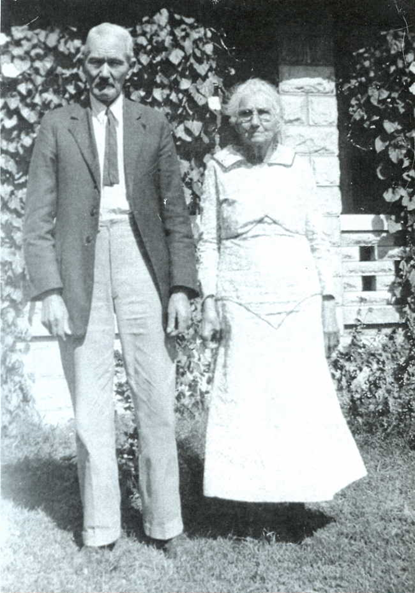
On 10 Oct 1875, John Duckworth, who nearly lost his life at Maddox Lane, married his second cousin, Elizabeth Ann Summers, and then immediately left Illinois. A St. Louis newspaper story of the 15 Jan 1876 Benton, Illinois, trial of Aaron Neal, the “reputed captain of the Ku-klux klan,” for his role in the Maddox Lane incident stated

"A much stronger case could have been made for the people but for the absence of Jacobs and Duckworth, the chief prosecuting witnesses. The whereabouts of the last named gentlemen is not exactly known, but it is thought they are traveling for their health.”


John and Elizabeth Duckworth in Kentucky, c1935.

Like John Duckworth, William Washington Jacobs, a participant in the Maddox Lane incident, had been an informant, claiming that he had joined the Klan only to expose its activities. Jacobs and Duckworth were certainly “traveling for their health.” They had made enemies not only due to their KKK connection, but also because they had squealed. They had antagonized both sides.

John and Elizabeth first fled to Posey Co, Indiana, where the Duckworths had lived before moving to Franklin Co. But then traveled on to Union Co, Kentucky. John Duckworth died in Henderson Co, Kentucky, 10 Oct 1938. Jacobs and his wife headed to Perry Co, Illinois, where he died 3 May 1921.

And that’s our final blog about the KKK of Franklin Co. It is planned and hoped that future tales of the Delaware Summers will be much more favorable.

Thursday, January 11, 2024

The Battle of Maddox Lane

The beginning of the end of KKK activities in Franklin Co (at least for a while) occurred at the “battle of Maddox lane,” There, it is said, “the Klan met their real Bull Run, Appomattox, and Waterloo.”

In the summer of 1875, the Klan was planning two Franklin Co “hits”—Capt. John Hogan and John B. Maddox. Hogan had earned Klan wrath because he had the audacity to prosecute Hiram Summers, a Klan member and liquor dealer in the village of Speakeasy, for selling Hogan’s son whiskey. Hogan had been ordered by the Klan to reimburse Hiram for his $100 fine and for costs. Maddox was on the Klan’s hit list because he had “been a little too free with women and with Rice’s wife.” We don’t know who Rice was, but he probably had Klan connections. A Klan member, William Washington Jacobs, turned informant and let Maddox and Hogan know of the Klan’s plans. They, in turn, asked authorities for help.

Very early the morning of 17 Aug 1875, a group of armed and masked men on horseback were caught approaching the farmhouse of John Maddox a few miles north of West Frankfort and just east of what is today Deering Road. A sheriff’s posse, waiting in ambush along the lane, opened fire with shotguns. One masked rider, John Duckworth, tumbled from his horse. The others, several also wounded, fled but were hunted down and eventually arrested.

Believing he was on his deathbed, the downed rider told all he knew about the Klan, continuing to spill the beans even after he survived. He had been initiated into the Klan by Hiram Summers, the Sneakout liquor dealer, at the farm lot of Elisha Summers. Some contemporary newspaper articles listed Elisha as Eli, but for a variety of reasons, we know it was probably not Eli. And who was the downed KKK rider, John Duckworth? It turns out he was John Wilson Duckworth, a son of Cassander Summers, Thomas Summers’s granddaughter! Hiram and Elisha Summers were brothers and Cassander’s cousins. It was all in the family. 

All in the Family

Were these members of the Summers family really KKK participants? Probably, though they may have just been ruffians, lawless individuals with a streak of cussedness. Let’s hope that was all it was because, as we will see, Summers participation was much, much more extensive than indicated here. 

Sunday, December 10, 2023

Sneakout

Around 1865 Thomas Jefferson (“Jeff”) Eubanks, a farmer in Cave Twp, Franklin Co, Illinois, established a sawmill on the west bank of Ewing Creek, where it was crossed by the road from Benton to Thompsonville. Houses were built for the new mill workers, a store was started, and a jail was erected. Why a jail in such a small community? It was probably needed. In addition to a handful of houses, a mill, and a store, the village had six saloons! Men (and it was only men in those days) sneaking out of their houses to booze it up gave the community its name, “Sneakout.” Yes, that was really the village name.

Sneakout had a bad name and a bad reputation. The village was not only a source of excessive drinking, aided by Hiram Summers, who supplied liquor, it was notorious for its roughness. Worse of all, Sneakout was headquarters of the KKK (sometimes called the “Golden Ring”) of Williamson and Franklin counties. The location was ideal for the Klan. Cave Twp bordered "Bloody" Williamson Co, and the area was isolated and lawless.

It was in Sneakout that Aaron Neal organized the group of masked miscreants, many of whom farmed in Cave, Frankfort (particularly in the Crawford’s Prairie area), and Eastern townships. Aaron, who was designated “Grand Master” and who claimed earlier membership in the original Klan, was everything a KKK member was not expected to be. He had served in the Union Army during the Civil War, he was the son of a Primitive Baptist minister, and he had read law, entering into private practice. Come to think of it, being a Baptist minister’s son might not have been a detriment at the time.

Church or school, possibly at Sneakout, Mar 2007.
Little, possibly nothing, remains of Sneakout today. During a 2007 trip, a search for the remnants revealed an old Church or School, but nothing else. The village vanished when good timber for the sawmill was used up and when a new train track ended its isolation. And the loss of saloon clientele when the KKK was (temporarily) vanquished also impacted the community. But more on that later.

Many Franklin Co towns have disappeared over the years. Sheldon R. Jones has produced an informative map of Franklin Co, showing its towns, both extant and extinct, and has granted permission to use it in the Summers book.

Map of Franklin Co, Sheldon R. Jones. Some locations are estimates. Sneakout has been marked with an added red arrow.


Sunday, December 3, 2023

The Egyptian Klan

With its large influx of southerners, Little Egypt, Southern Illinois, had a worrisome number of Confederate sympathizers during the Civil War. Active in the region was The Knights of the Golden Circle (KGC), a pro-slavery group. It was claimed that in 1862 Williamson Co had 1000 Knights, an incredibly large number considering that in 1860, the county had only 12,205 residents. It has been proposed that the KGC was the forerunner of the Ku Klux Klan (KKK) in Southern Illinois and certainly the viewpoints of the two organizations were similar.

The KKK originated in 1865 in Pulaski, Tennessee, and is said to have reached Southern Illinois by 1867. It had certainly arrived by 1871, when forty men attacked the farm of John Baker on the Williamson-Franklin county line, driving him and his family off. The following year, on 22 Apr 1872, fourteen (some say ten) riders in masks, robes, and pointed caps hung Isaac Vancil, a 73-year-old Williamson Co farmer known for his multitude of illegitimate children and rough, ignorant, and overbearing life style. Though the hanging was carried out in Williamson Co, members of the Franklin Co Klan were present. At least two trial witnesses who testified against the Klan for Vancil's slaying were afterwards murdered.

The seven southern Illinois counties with KKK activity, 1867–1875.

The Klan increased its activity, eventually operating in seven Southern Illinois counties: Franklin, Williamson, Jackson, Saline, Johnson, Union, and Pope. During 1874 and 1875, the "Egyptian Night Riders" claimed to have conducted about one hundred raids in Franklin Co. There was little activity against African Americans, who were nearly nonexistent in most of Southern Illinois. The Klan acted instead as vigilantes, claiming to right wrongs and to punish miscreants living immoral lives. In fact, much of the activity appears to have been to settle personal grudges. One newspaper reporter at the time said the cause was just “inherent ‘cussedness’.”

Were the night riders in Southern Illinois really the Ku Klux Klan? They called themselves Klansmen, their dress and oaths resembled those of the original Klan, and they were considered KKK members by government officials and newspaper reporters. If it walks like a duck…

On the other hand, the Illinois organizations appeared to be relatively nonpolitical. Some members were even said to be Republican, an absolute “no-no” for Klan members in the deep south. And some Illinois Klansmen had fought in the Union Army during the Civil War. But, for convenience, we will continue to refer to the Southern Illinois masked rider groups as the KKK. They certainly believed they were.

St. Louis Republican newspaper, 23 Aug 1875

Dr. Andy Hall, a prominent early 20th century Mt. Vernon, Illinois, physician, who lived in Franklin Co at the time of the KKK, has described their activities. 

The headgear of the Franklin county. clansmen consisted of a tall white cap with peep holes and a long flowing robe that covered the entire body. And as they always completely covered with white blankets, even the heads of the animals except for the peep holes through which to see. This was to prevent the possible identity of the animal, disclosing the name of the rider.


 At one time they were so numerous and active in that community that one could seldom start out on the highway without meeting from ten to thirty clansmen. Their principal activities were directed to supervising all the social, moral and business affairs of the community. Unfortunately they administered punishment to their personal enemies and to those who dared to disobey their orders or warnings. For several months they carried on unmolested, visiting isolated farm houses in the dead hours of the night, called the occupants outside and warning them what they should do or should not do and frequently punishing them in various ways.

But what does all of this have to do with the Summers family? We shall soon see.

Tuesday, November 28, 2023

Little Egypt

During the “Winter of the Deep Snow” in 1830-1831, and some severe winters following, counties in the south of Illinois supplied food to the northern part of the state, an action that may have given rise to the name “Little Egypt” or just “Egypt” for Southern Illinois

There is an old tradition handed down from the early settlers along this road about the people coming down from the north to buy corn in an early day. The frost having killed all the corn in the north, in the southern part of Illinois the corn was not hurt by frost. The people near Goshen had come down the Old Goshen road to Knight's Prairie west of McLeansboro where they stopped to stay over night with one of the early settlers by the name of Knight. The corn buyers accosted the early settler by using the Bible expression “We are the son of Jacob and have come into the land of Egypt to buy corn.” From this expression we derived the cognomen of 'The land of Egypt.” Since then all Southern Illinois is known as 'EGYPT" or The land of Egypt." (H. M. Aiken, Franklin County History, Centennial Edition)

 It is sometimes claimed the southernmost Illinois city was given the name “Cairo” because it lay in “Little Egypt,” but the reverse may be true. On 9 Jan 1818 the governor of Illinois territory signed into law an act to incorporate the “City and Bank of Cairo.” The city was named well before the food shipments following the winter of 1830 and afterwards. Perhaps the position of Cairo at the confluence of the Ohio and Mississippi rivers, reminded the founders of the Egyptian Delta. But, of course, there may have been earlier food shipments.

 And the Egypt designation could have began in 1799 when Baptist minister John Badgley termed the fertile lands near southern Illinois town of Edwardsville, Illinois, the “Land of Goshen,” a Biblical area in Egypt.

City of Cairo, Illinois, panoramic map, 1885.

Southern Illinois, “Little Egypt,” was known for its huge coal deposits, though the Summers family was apparently never involved with this. And it was also known for its large concentration of settlers from southern states, such as North Carolina and Tennessee, from which the Franklin Co Summers immigrated.

In his 1918 book on the history of Franklin Co, H. M. Aiken states

The early settlers of the county who came from the South, brought with them, a hospitality and sociability, that could not be excelled anywhere in the U. S. The typical Yankee possessed many good traits of character but the genuine hospitality and sociability of the people of the South was a great inheritance of which Franklin County received in her early days.

Franklin County is indebted to her early settlers for the gentle, Christian spirit that had been a great factor in moulding[sic] the character of the founders of Franklin County.

Joy, peace, and contentment and affection encompassed and enveloped their homes. Southern ideas govern our social intercourse and Southern hospitality is dispersed. The traveler passing through the county upon our public highways is always greeted with an affable "Good-day, Sir," and if he should stop at a farm house in quest of information he will be politely invited to 'light and come in." Refreshments will be offered him so cordially and unostentatiously that he at once concludes that he has found a county where kindness, chivalry and hospitality do not entirely belong to the ages that are past.

 No description could be further from the truth. Inhospitable and unsociable, Southern Illinois had a plethora of crime and violence. In 1875 a newspaper reporter described Little Egypt residents as 

Dirty roughs, clad in two shirts, butternut homespun, and cowhide boots, hanging round the "drug stores" (here grogshops are so designated), to drink benzine, discuss who is "the best man," and, if enough benzine have been consumed, to settle that great question by fighting it out then and there. Men, as one soon learns of them, who are born bullies, every mother's son of them, and who are so proud of nothing as having knocked down some other man, and, while he was down, kicked, choked, bit, and gouged him, until the victor has spent his strength and his rage.

The stereotypic resident was said to be “lazy, ignorant, anti-intellectual drunkard who loved a good fight and held the law in slight regard” (Illinois Historical Journal, Spring, 1985, pp. 17-44). Assaults and murders were rampant, particularly in Williamson Co, with its vicious family vendettas, but also in adjacent Franklin, Jackson, and other Litte Egypt counties. Suspects usually escaped punishment owing to badly managed prosecutions; lying, threatened, or murdered witnesses; and biased or frightened juries. And all too often they were simply "nolled" (legal slang from L. nolle prosequi, charges dismissed) for no apparent reason.

Counties in black voted for the constitutional convention
that could have legalized slavery.

Little Egypt was exceedingly racist, particularly the city of Cairo, home to a large number of blacks, estimated at more than ten thousand during the Civil War, mostly fugitive “contrabands.” About three thousand remained in the city after the war. Though the first Illinois state constitution, published in 1818, stated that slavery shall not be “thereafter introduced,” slavery continued to be tolerated. The historian Darrel Dexter has described Illinois as a "quasi-slave" state. Use of slaves was allowed by law until 1825 for the salt works in the southern Illinois county of Gallatin. Documents show that at least five southern counties—St. Clair, Gallatin, Randolph, Edwards and Pope, where blacks were bought, sold, indentured, gifted, and taxed as property—embraced the institution of slavery. In 1853 the state legislature passed a law which made the settlement of African Americans in Illinois a crime. If African Americans remained in Illinois beyond 10 days, they could be arrested and fined.

The 1818 Illinois census for statehood showed Franklin Co with only sixty-seven blacks, fifteen “indentured” (slavery by another name) and fifty-two free. But, despite these low numbers, Franklin certainly supported slavery. When a vote was taken in Illinois in 1824 for or against a constitutional convention that could have made slavery legal outright, Franklin was one of eleven southern Illinois counties with a majority of votes for the convention. In Franklin Co, the vote was 170 for and 113 against. But Illinois, as a whole, voted 4972 for and 6640 against. Had the measure passed, the course of Illinois history would have been much different.

In 1876, after defending several clients accused of “crimes that would make the bailiffs of Hades blush,” the magniloquent lawyer Milo Erwin wrote a book about Williamson Co, inviting the world “to look with joy and pride upon a county redeemed from crime, and sparkling with brilliant gems of innocence and virtue.” Any sparkle was short-lived. Crime and violence continued in Williamson and the rest of Little Egypt, culminating in the 1920s with violent labor strikes, prohibition violence, and the rise of the Ku Klux Klan. But, as we will see in our next blog, the latter was not a rise but a rebirth.

And this was home for the Wittenberg Summers Line! But crime-ridden Egypt may have been more than just their home. As we will see, it may have been their cultural cradle.


Darrel Dexter, Bondage in Egypt, Slavery in Southern IllinoisSoutheast Missouri State University, Cape Girardeau, Missouri, 2010.

Thursday, November 16, 2023

Franklin County Homelands

At the corner of Bolen Store and Green Mountain roads in Eastern Twp, Franklin Co, Illinois, stands Mount Etna Methodist Church. Alongside the church is a stone tablet stating that the church was organized in 1822 by Rev. John Launius (the tablet misspells the name), Edward Sullivan, Thomas Summers, and their wives. A written history of the church reveals “The meetings at first were held in brush harbors and in the people’s homes, the home of Thomas Summers being used most. This home was located a little more than a quarter of a mile east of the present site of the church.” Thomas Summers Sr's family, who were in Sumner Co, Tennessee, in 1820, had moved to Franklin Co by 1822.

The church founders had close ties. In Franklin Co at least eleven of Reverend Launius's descendants wedded a Summers, every one related to Thomas. And three of Edward Sullivan's daughters married two of Thomas's sons. (One son, Braxton Parrish Summers, was married twice, to Sullivan sisters.) 

Typical home of early Franklin Co settlers (H. M. Aiken,
Franklin County History, Centennial Edition, 1918.)
When Thomas Summers Sr arrived around 1822, Franklin Co was  still on the frontier. The first permanent European residents had showed up just a few years earlier, around 1812. Thomas was probably the first person with the name "Summers" to live in the county. The 1820 Franklin Co census shows not a single person with that name. By 1870, 168 people with the name “Summers,”  resided in Franklin Co, 132 of them in Eastern Twp. Most, possibly all, were related to Thomas, mainly descendants, but also siblings, cousins, nieces, nephews, and Summers spouses.

Franklin has twelve civil townships – Goode, Barren, Ewing, Northern, Tyrone, Browning, Benton, Eastern, Six Mile, Denning, Frankfort, Cave. Most of the Summers families lived in Eastern Twp. A few lived in Cave and Northern townships. And later some migrated into Frankfort and Denning townships.

Franklin Co, 1870 (Atlas of Illinois, Warner and Beers, 1870).

In 1853 Thomas received 80 acres in Section 28 of what corresponds to Eastern Twp for his military service in the War of 1812. His new property was just down the road from Mt. Etna Church. In the 1850s and 1860s Thomas Sr’s sons William K, James, Elias, Alexander, Peter, and Braxton Parrish purchased properties near their father’s bounty land. One of those sons, William K. would continue the Wittenberg Summers Line when Thomas Sr died 5 Oct 1864. 

But before leaving Franklin Co, we have a shocking tale to reveal. Starting with our next blog, “Little Egypt,” we will see that living in Franklin Co was not all roses for the Summers and other residents. Far, far from it.

Tuesday, November 14, 2023

Franklin County


Joseph's Journey
Joseph Summers, a progenitor in the Wittenberg Summers Line, which we are following, spent his early years, 1749–1772, in Kent Co, Delaware, then resided in Guilford Co, North Carolina, 1772–1796. His next destination was Sumner Co, Tennessee, where he spent the years 1796–1829, most or all with his wife, Mary Jackson Summers. Joseph lived out the final years of his life, 1829–1839, in Morgan Co, Illinois, though he died in the adjacent county, Scott, possibly because his residence was in the portion of Morgan Co from which Scott Co was formed in 1839. Though Joseph ended up in Morgan Co, Illinois, as did several of his offspring, other sons and daughters, those that decided to leave Tennessee, ended up in Southern Illinois, in the counties of Franklin, Williamson, Gallatin, White, and Saline. In particular, Joseph’s son Thomas Sr. and all but one of Thomas’s thirteen children lived at least part of their lives in Franklin Co. And this is important since Thomas Sr. was the next progenitor of the Wittenberg Line. Confused? Take a look at this family branch in the Summers blog "In a Nutshell".

In many ways, the cradle of the Wittenberg Summers was Southern Illinois, not Delaware, not North Carolina, not Tennessee, not even Missouri. For nearly two centuries, starting around 1822, descendants of Thomas Summers Sr. have proliferated in Southern Illinois, with most living in Franklin Co.

 On 2 Jan 1818, eleven months before Illinois was established as the twenty-first state (3 Dec 1818) and four or so years before the arrival of the first member of the Wittenberg Summers Line (c1822), Franklin Co was created from parts of Gallatin and White counties. Originally twice its present size, Franklin Co was divided in half in 1839 forming the new county of Williamson to the south. Franklin lies in the center of Southern Illinois, midway between the Wabash and Mississippi rivers and more or less midway between the southern tip of Illinois and the ill-defined northern border of Southern Illinois.
Counties in southern Illinois before becoming a state
Southern Illinois today